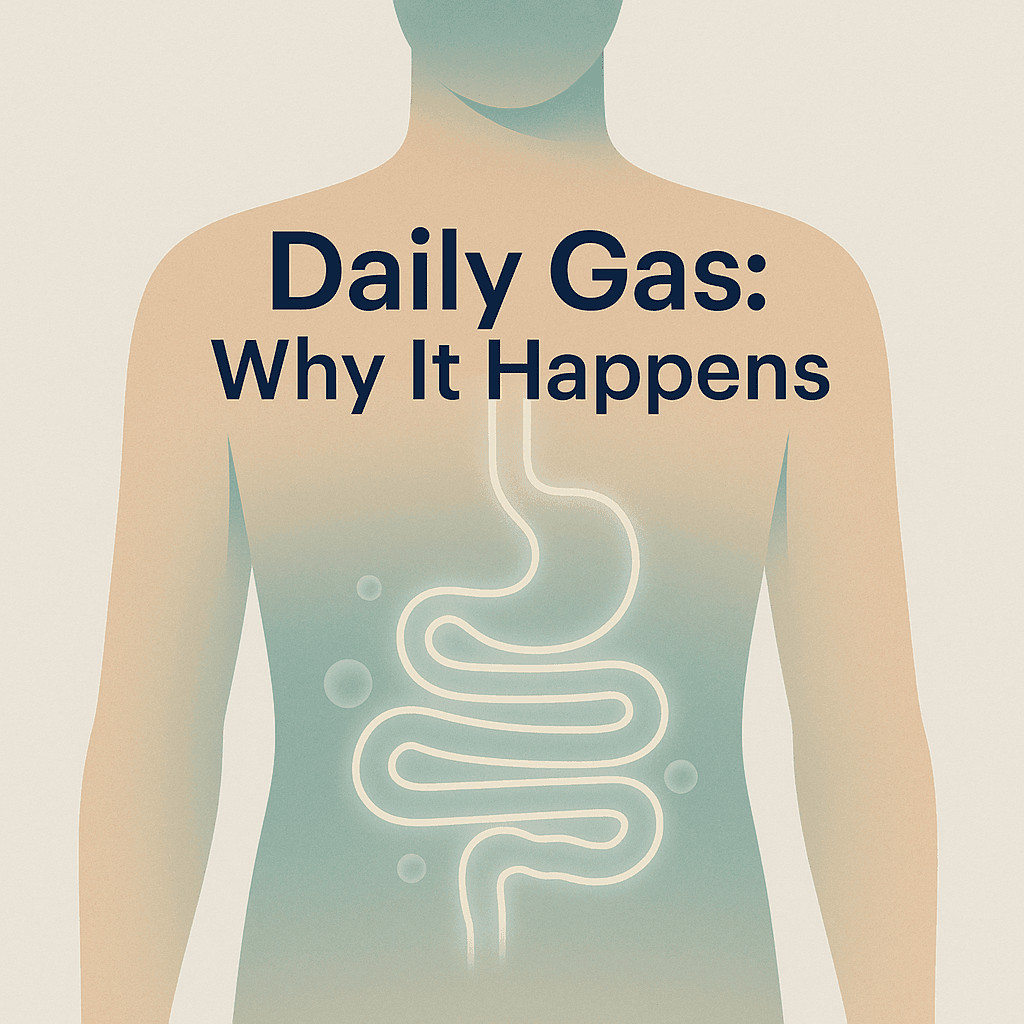
Why You Have Gas Every Day
That said, daily gas can be annoying, embarrassing, and sometimes painful. Let’s break down the most likely reasons it’s happening and what you can do to calm it down.
First, what “gas” actually is (and why it happens)
Gas comes from two main places:
- Air you swallow (from eating fast, talking while eating, chewing gum, carbonated drinks, smoking, or mouth breathing).
- Fermentation in your colon (your gut bacteria break down carbs and fibers that weren’t fully digested in the small intestine).
A healthy gut produces gas. The goal isn’t to have zero gas. The goal is to reduce excess gas, bloating, discomfort, and frequent symptoms that feel out of proportion.
How much gas is normal?
Most people pass gas anywhere from about 10 to 20 times per day. So if you’re thinking, “Wait, that’s normal?” yes, often it is.
What’s more important than the number is the pattern:
- New or suddenly worse gas
- Gas with significant pain or swelling
- Gas plus diarrhea, constipation, or reflux
- Gas with weight loss, blood in stool, anemia, fever, or waking at night from symptoms
If any of those apply, skip to the “When to see a doctor” section.
1) You’re eating gas-producing foods (even “healthy” ones)
Some foods naturally create more gas because they contain fibers and carbs that are very fermentable. That doesn’t mean they’re bad. It just means your gut bacteria love them.
Common culprits include:
- Beans and lentils
- Cruciferous veggies: broccoli, cauliflower, cabbage, Brussels sprouts
- Onions and garlic
- Apples, pears, mango
- Whole grains and bran
- Dairy (for lactose-intolerant people)
- Sugar alcohols: sorbitol, xylitol, mannitol (common in “sugar-free” gum/candy and some protein bars)
If your daily gas started after you “cleaned up” your diet and added more fiber, this is a big clue.
What to try: Reduce the top suspects for 10 to 14 days, then reintroduce one category at a time. You’re looking for patterns, not perfection.
2) You’re eating too fast or swallowing extra air
This is one of the most overlooked causes of everyday gas, especially if you also burp a lot.
Signs it might be air-swallowing (aerophagia):
- More burping than farting
- Gas worsens when you’re stressed or rushing
- You chew gum, drink through a straw, or sip fizzy drinks often
- You feel “full of air” soon after eating
What to try:
- Slow meals down. Aim for 15 to 20 minutes per meal.
- Chew thoroughly.
- Cut back on gum, hard candy, straws, and carbonated drinks.
- If you’re a mouth breather due to congestion, addressing that can help too.
3) Your gut bacteria are out of balance (and fermenting aggressively)
Your microbiome plays a huge role in gas. Two people can eat the same meal and have totally different results depending on their gut bacteria.
Daily gas can happen when:
- Your gut microbes are producing more gas than usual
- You have an overgrowth of certain bacteria
- Food is reaching the colon less digested than it should
This is why some people feel like they can’t tolerate foods they used to eat just fine.
What to try: Don’t jump straight into random probiotics. Start with basics that shift the gut environment gently:
- Regular meal timing
- More soluble fiber (like oats, chia, psyllium) instead of huge raw salads
- Reduce ultra-processed foods and excess sugar
- Consider a short trial of a targeted approach like low FODMAP (more on that below)
4) You might be lactose intolerant (even if you “used to handle dairy”)
Lactose intolerance can show up later in life, and it doesn’t always mean immediate, dramatic symptoms. Sometimes it’s just daily gas, bloating, or loose stools. According to the Mayo Clinic, this condition can develop at any age.
Dairy triggers often include:
- Milk
- Ice cream
- Soft cheeses
- Whey-heavy protein shakes
What to try: Remove lactose-containing dairy for 2 weeks. If symptoms improve, you can test:
- Lactose-free milk
- Hard cheeses (lower lactose)
- Lactase enzyme tablets with dairy
5) FODMAPs: the “healthy foods” that can backfire
FODMAPs are certain types of carbohydrates that are poorly absorbed in the small intestine and easily fermented by gut bacteria. For people with sensitive digestion (especially IBS), high-FODMAP foods can create daily gas and bloating.
High-FODMAP foods commonly include:
- Onions, garlic
- Wheat-based bread/pasta
- Beans
- Apples, pears, watermelon
- Milk (lactose)
- Honey and high-fructose sweeteners
What to try: A short-term low FODMAP trial can be very effective, but it’s best done carefully and temporarily. The idea is:
- Reduce high-FODMAP foods for a few weeks
- Reintroduce systematically to find your specific triggers
If you suspect IBS, working with a registered dietitian is ideal because low FODMAP is not meant to be a forever diet.
6) Constipation and “slow transit” can trap gas
You can have daily gas simply because stool is moving slowly. When things sit in the colon longer, bacteria have more time to ferment, and gas builds up.
Signs constipation may be part of the problem:
- Fewer than 3 bowel movements per week (or incomplete emptying)
- Hard stools
- Straining
- Gas and bloating that improve after a bowel movement
What to try:
- Hydration (especially if you increased fiber)
- Gentle daily movement (walking is underrated for gut motility)
- Soluble fiber like psyllium (start low and go slow)
- Magnesium glycinate or citrate can help some people, but check with your clinician if you have kidney disease or take medications
7) You’re getting too much fiber too fast
Fiber is great, but if you go from low fiber to high fiber overnight, daily gas is basically guaranteed.
This often happens when people suddenly add:
- Big salads
- Bran cereal
- Multiple fiber supplements
- Lots of beans and lentils
- Protein bars with added fibers like inulin or chicory root
What to try: Increase fiber gradually over 2 to 4 weeks. If you use supplements, start with a small dose and build up.
Also, pay attention to ingredients like:
- Inulin
- Chicory root
- Fructooligosaccharides (FOS)
These can be very gassy for some people, even in “healthy” foods.
8) You may have IBS (irritable bowel syndrome)
IBS is extremely common, and gas and bloating are classic symptoms. IBS usually includes a pattern of:
- Abdominal discomfort
- Bloating or excess gas
- Changes in stool (diarrhea, constipation, or both)
- Symptoms that flare with stress, certain foods, or hormonal changes
IBS doesn’t mean something is “seriously wrong,” but it does mean your gut is more sensitive and reactive.
What to try: IBS tends to respond well to:
- Identifying trigger foods (often FODMAP-related)
- Regular eating schedule
- Stress support (because the gut and brain are tightly linked)
- Treating constipation or diarrhea consistently rather than randomly
Additionally, it’s important to focus on improving your gut health overall. Following an essential checklist to boost your gut microbiome diversity can be beneficial in managing IBS symptoms and reducing gas and bloating.
9) SIBO: when gas comes with noticeable bloating and food sensitivity
SIBO (small intestinal bacterial overgrowth) is when bacteria that normally live lower in the gut become more concentrated in the small intestine. That can lead to fermentation happening “too early,” creating gas, bloating, and discomfort.
Common signs people report:
- Bloating soon after meals
- Gas that seems out of proportion to what you ate
- New sensitivities to many foods
- Alternating diarrhea and constipation (varies)
SIBO is tricky because symptoms overlap with IBS, and testing is imperfect. Still, if your gas is daily, persistent, and paired with significant bloating after meals, it’s worth discussing with a clinician.
10) Gluten isn’t always the issue, but wheat sometimes is
Some people feel better off gluten, but the improvement is often because they reduced wheat-based FODMAPs, not necessarily gluten itself.
If bread, pasta, and baked goods trigger gas, the cause could be:
- Fructans (a FODMAP in wheat)
- Large portion sizes
- Additives in processed baked goods
Important note: If you suspect celiac disease, don’t remove gluten before testing. You need to be eating gluten for the tests to be accurate.
11) Carbonated drinks and “gut-friendly” fizzy stuff
Sparkling water, soda, kombucha, and beer can all add gas simply by adding gas. Even if your digestion is perfect, carbonation increases the air in your GI tract.
Also, kombucha and some “prebiotic sodas” include fermentable ingredients that can add another layer of gas for sensitive guts.
What to try: Take a 7 to 10 day break from carbonated drinks and see what changes.
12) Stress can change your digestion more than you think
The gut and nervous system talk constantly. When stress is high, digestion often changes in very real ways:
- You swallow more air
- Gut motility can speed up or slow down
- Your gut becomes more sensitive to normal amounts of gas
If your gas is noticeably worse during busy periods, travel, poor sleep, or anxiety, this matters.
What to try: You don’t need to “just relax.” Use practical levers:
- Walk after meals
- Eat without multitasking when possible
- Prioritize sleep
- Try slow breathing for a few minutes before eating if you tend to eat in a stressed state
A simple 7-day plan to reduce daily gas (without overcomplicating it)
If you want a practical reset, try this for one week:
- Cut carbonation (sparkling water included).
- Pause sugar-free gum/candy and products with sugar alcohols.
- Choose cooked veggies over large raw salads.
- Reduce onions and garlic temporarily (very common triggers).
- Keep beans and lentils small or skip for the week.
- Eat slower and sit down for meals.
- Walk 10 minutes after meals to help motility.
At the end of 7 days, ask:
- Is the gas less frequent?
- Is bloating less intense?
- Is it more “normal” and less painful?
If yes, you’ve got useful clues. Then you can reintroduce foods one by one.
When to see a doctor (don’t ignore these)
Daily gas is usually benign, but get medical advice if you have:
- Blood in stool (bright red or black/tarry)
- Unexplained weight loss
- Persistent vomiting
- Fever
- Anemia
- Severe or worsening abdominal pain
- New symptoms after age 50
- Waking at night due to GI symptoms
- Family history of colon cancer, IBD, or celiac disease
- Gas with persistent diarrhea or significant constipation that isn’t improving
These don’t automatically mean something serious is happening, but they do deserve proper evaluation.
The bottom line
Having gas every day usually comes down to one of a few themes: fermentable foods, swallowing air, constipation, food intolerances (like lactose or FODMAPs), IBS, or changes in your gut microbiome.
The good news is you can often improve it without extreme diets or guessing forever. Start by simplifying: slow down meals, reduce carbonation and sugar alcohols, watch fiber timing, and test common triggers in a structured way.
If your symptoms are intense, new, or paired with red flags, bring it to a clinician. You deserve an answer that’s more specific than “it’s probably just something you ate.”
FAQs (Frequently Asked Questions)
What causes daily gas and is it normal to have gas every day?
Daily gas is caused mainly by air you swallow while eating or drinking and fermentation of undigested carbs by gut bacteria in your colon. It’s normal to pass gas about 10 to 20 times per day. The goal is not zero gas but reducing excess gas, bloating, and discomfort.
Which foods commonly cause increased gas and bloating?
Foods that are high in fermentable fibers and carbohydrates often cause more gas. Common culprits include beans, lentils, cruciferous vegetables (like broccoli and cauliflower), onions, garlic, certain fruits (apples, pears, mango), whole grains, dairy for lactose-intolerant people, and sugar alcohols found in sugar-free gum or candies.
How does swallowing air contribute to excessive gas and how can I reduce it?
Swallowing extra air (aerophagia) through fast eating, talking while eating, chewing gum, using straws, drinking carbonated drinks, or mouth breathing can increase burping and gas. To reduce this, eat slowly over 15-20 minutes, chew thoroughly, avoid gum and fizzy drinks, and address nasal congestion if you’re a mouth breather.
Can an imbalance in gut bacteria cause daily gas?
Yes. Your gut microbiome influences how much gas is produced during fermentation. An imbalance or bacterial overgrowth can lead to increased gas. Improving gut health through regular meal timing, increasing soluble fiber intake (like oats and chia), reducing processed foods and excess sugar can help balance gut bacteria.
Is lactose intolerance a possible reason for daily gas even if I used to tolerate dairy?
Absolutely. Lactose intolerance can develop at any age and may present as daily gas, bloating or loose stools after consuming dairy products like milk, ice cream, soft cheeses or whey protein shakes. A two-week trial removing lactose-containing dairy can help identify if lactose intolerance is the cause.
What are FODMAPs and how do they affect daily gas and digestion?
FODMAPs are certain carbohydrates poorly absorbed in the small intestine that ferment easily in the colon leading to gas and bloating especially in sensitive individuals like those with IBS. High-FODMAP foods include many ‘healthy’ options; managing intake through a low-FODMAP diet can reduce daily gas symptoms.